Four things, in order.
Most career tools give you a score and leave. This one is built around what happens after: what you own, what to do about it next, and what you keep when you leave.
01See where you stand
about 3 minutes, free
Your CV read into a map of your skills, an AI readiness check, and your occupation set against real AI-usage data. One read: strengths, gaps and what the market is doing.
02Pick your focus
3 minutes, then 30 days
Rate yourself on the four areas your read points to and choose up to three to work on for thirty days. The number moves when you do the work.
03Practise on real work
one workflow a week
A workflow from your own job, at your AI level, run in the assistant you already use. Every run and every learning goes into your log.
04Keep the proof
ongoing
Reputation earned inside a company is invisible outside it. A profile you publish, and a Hive of people in your field doing the same work.
Act 1 — about 3 minutes, free
See where you stand
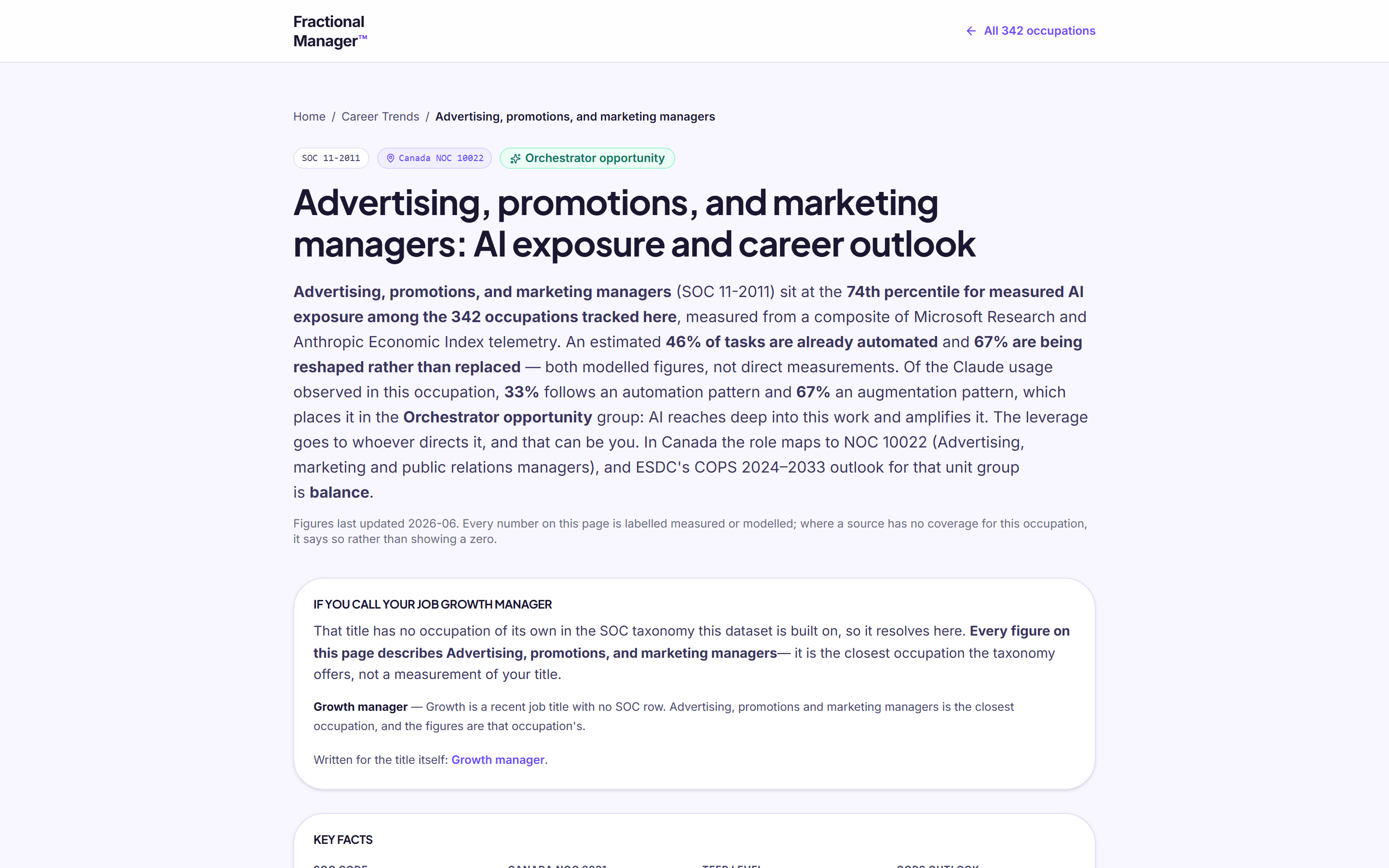
Occupation intelligence
Where your profession actually stands, measured from real AI-usage data.
- 342 occupations, each with its own page
- AI applicability per occupation from Microsoft Research, scored against O*NET work activities
- Observed AI usage from the Anthropic Economic Index
- The verbatim O*NET 31.0 task statements for your role, ranked by measured automation share
- Canadian NOC 2021 concordance and the ESDC COPS 2024-2033 outlook
- A three-question qualifier for seniority, work mix and employer adoption
A cited read on your role in about ten seconds, before you give us anything.
What it won’t do. Where a source has no data for an occupation you see “not available”, not a number we invented. Every figure is labelled measured or modelled, and we say what it was modelled from.
The live component, with a sample profile. Yours is built from your own resume. Tap any star for details.
Skills Constellation™
Your resume, read into a map of what you can actually do.
- Core competencies, each carrying its own sub-skills
- Accomplishments with the metrics lifted off your own CV
- Transferable skills and work traits as their own clusters
- Every skill editable, because a parser gets things wrong
- One PDF, about thirty seconds to parse
Your experience as a structure you can correct and reuse, instead of two pages of prose you rewrite every time someone asks.
What it won’t do. It reads what your CV says. Work you never wrote down is work it cannot see — which is usually the first thing worth fixing.
More on Skills Constellation™AI Litmus
Where you actually sit on the AI spectrum, and what the next rung is.
- One placement question, then six adaptive ones
- About three minutes
- Four dimensions: personal AI usage, role integration, automation mindset, agent awareness
- Five named levels, AI Observer through Agent Orchestrator
- Feedback after each answer, not a score at the end
A level with a name and a specific next step, rather than a generic course list.
What it won’t do. It is a self-assessment, and it says so. Evidence of real AI work is tracked separately and shown beside your level — never silently over it.
More on AI LitmusAct 2 — 3 minutes, then 30 days
Pick your focus
Identity & Positioning
▲1Rated 4 of 5 · Strong
Output & Credibility Assets
▲1Rated 3 of 5 · Making progress
AI-Enabled Capability
▲2Rated 4 of 5 · Strong
Learning & Growth
Rated 4 of 5 · Strong
Reputation & Influence
Rated 3 of 5 · Making progress
Relationship Quality
Rated 3 of 5 · Making progress
Network Strength
▼1Rated 2 of 5 · Early stage
Opportunity Flow
Rated 2 of 5 · Early stage
Autonomy & Choice
Rated 3 of 5 · Making progress
Wellbeing & Sustainability
Rated 3 of 5 · Making progress
Self-reported — no product signal
Financial Health
Rated 2 of 5 · Early stage
Self-reported — no product signal
A sample cycle. The ringed three are the ones this person chose to focus on; the arrows are movement since their last assessment.
Success Metrics
Eleven pillars, scored by you, corroborated where we have signal and labelled where we don't.
- Eleven pillars, from Identity & Positioning through to Financial Health
- Self-rated 1 to 5, with up to three chosen as your focus
- An action ladder per pillar whose first rung takes about twenty minutes
- A delta against your last cycle, so you see movement rather than a standing score
- A 30-day cycle
One specific next action, and a number that moves when you do the work.
What it won’t do. Wellbeing and Financial Health carry no product signal, so they stay self-reported and are labelled that way. Capability pillars only clear when your rating actually moved — deliberately, because otherwise the ladder rewards busywork.
More on Success MetricsAct 3 — one workflow a week
Practise on real work
Weekly AI workflows
One real task from your own job, done with AI, at your level.
- Role workflows for Sales and Marketing now; Finance and Customer Service are in review
- Four levels, from a single prompt (Assist) up to designing a system (Design), matched to your AI readiness
- Picked for you from what your CV keeps coming back to
- Each one checked by a named person before members can see it
- Log how it went: used as is, used with edits, or didn't work
Practice on the work you are already paid for, which is what a course cannot give you: Monday morning, with AI, on a real deliverable.
What it won’t do. A workflow is a starting point, not a finished answer. You still check the output, and a field only gets workflows once a person has verified them.
More on Weekly AI workflowsLearning log
Everything you practised and learned, in one place, whoever logged it.
- Workflow runs, things you learned, and wins logged from your AI assistant, in one timeline
- Each entry says who logged it: you, Fractional Manager, or your assistant
- A prompt to add a takeaway to anything you haven't reflected on yet
A record of real AI work that travels with you, instead of a certificate that says you watched something.
What it won’t do. It holds what you or your assistant log. Work you do with AI and never log is work it cannot show.
More on Learning logAI connector
Fractional Manager as a tool inside Claude or ChatGPT.
- A personal access token you mint in settings
- Works with any MCP client
- get_my_workflows and get_workflow — run a workflow for your own job, step by step, inside your assistant
- log_workflow_run and log_ai_win — record real work you did with AI, mid-task, without leaving your assistant
- recommend_learning and get_my_metrics, answered from your own data
Your assistant already knows what you just built. This is how that becomes evidence you own, without retyping it into another dashboard.
What it won’t do. An MCP server cannot read your conversation — the protocol hands it only the arguments you pass it, and we do not work around that. Logging happens when you ask for it, and nothing else is captured.
More on AI connectorAct 4 — ongoing
Keep the proof
The live meter. It names what is missing rather than only scoring you.
Public profile
Proof of what you own, at a URL that belongs to you.
- A published page carrying your constellation
- A sixty-second video you can record on your phone through a QR handoff
- Accomplishments, projects, education and certifications
- Cards from real business briefs you completed and were scored on
- A strength meter that names what is still missing rather than just scoring you
- Publish and unpublish whenever you want
Reputation earned inside a company is invisible outside it. This is the part that leaves with you.
What it won’t do. A profile is an artifact, not an audience. Publishing it does not put it in front of buyers — that part is still your work.
More on Public profileThe Hive
A small, invite-led room of people making the same move.
- Channels by field and topic, with threads and replies
- Direct messages and a member directory
- Curated reading posted as real messages from a person, not a bot account
The one thing a dashboard cannot give you: someone who has already hit the problem you are on.
What it won’t do. It is deliberately small and deliberately quiet. Curated posts are capped at two items, twice a week, and nobody is emailing you a digest.
More on The HiveField Pulse and AI Toolkit
What is moving in your field, and the AI tools people in it actually use.
- Dated trend cards, each linked to its sources and to a workflow that acts on it
- Live posts from vetted sources and people worth following in your field
- AI apps, online tools and agents curated per field, each with why it is trusted
- A tool spotlight in the #ai-toolkit channel, where members compare notes
Stay current without doom-scrolling: a short, sourced feed for your field, with the work to do about each item.
What it won’t do. Curated for Sales and Marketing first. Other fields get the role briefing until their toolkit has been checked tool by tool.
More on Field Pulse and AI ToolkitStart with the part that costs nothing
10 features listed here, every one of them something a member can open today.