For career development practitioners
Your clients' ladder is losing its rungs. Give them a structure they can climb.
Onboard a client who has been laid off or wants to pivot, run three 30-day cycles with them on one instrument, and hand them a record they keep. You bundle access into the fee you already charge. Cohort 1 is free and starts in October 2026.
Execution is being automated. Value now has to be defined, not just delivered. That is the conversation career development is turning into, and it needs a scorecard the client owns.
What changed
The repeated part of career work is going to AI too
The first rung is the one going. Young workers in the occupations most exposed to AI are being hired less, and the gap has widened over the past year rather than closing.
Employment of 22–25-year-olds in highly AI-exposed occupations sits about 19% below where it would be had it tracked less-exposed peers; 15% at the July 2025 vintage.
Brynjolfsson, Chandar and Chen, Stanford Digital Economy Lab · 2026-08-12 · verified 2026-09-18
The demand side is moving toward exactly the shape this instrument prepares a client for: specialised capacity bought in fractions rather than full-time headcount.
77% of business leaders say AI is increasing their need for specialised, fractional talent rather than traditional full-time roles.
A marketplace reporting on demand for the thing it sells. Read as a direction, not a measurement of the whole labour market.
Upwork Research Institute, In-Demand Skills 2026 · 2026-02-04 · verified 2026-09-18
Practitioners are already using AI with clients, mostly without training, and mostly without trusting it. That gap is the reason an instrument has to be honest about what it measures and what it cannot.
Of 370 Canadian career development practitioners surveyed, 84% already use AI with clients, 82% have had no formal training, and 7% believe current AI systems are fair and unbiased.
Canadian Career Development Foundation, dmh associates and CareerChatUK, via Magnet · 2026-06-12 · verified 2026-09-18
Few practitioners feel ready to fold AI into practice, which is a different problem from whether they use it.
Only 14% of career professionals feel fully prepared to integrate AI into their practice.
CERIC survey, reported in CareerWise by Shreya Urvashi · 2026-08-18 · verified 2026-09-18
For the clients who do go independent, the work comes through people they already know. A client whose whole network was inside one building starts with the pipeline that this instrument's relationship metrics are built to make visible.
94% of fractional workers have won clients through network referrals, and 72% found their first fractional client through someone in their personal network.
A job board surveying its own members, who are already fractional. It describes how the people who made it found work, not how many tried.
Fractional Jobs, The Fractional Work Report 2026 · 2026 · verified 2026-09-18
The instrument, as it ships
What a client does in the first seven minutes
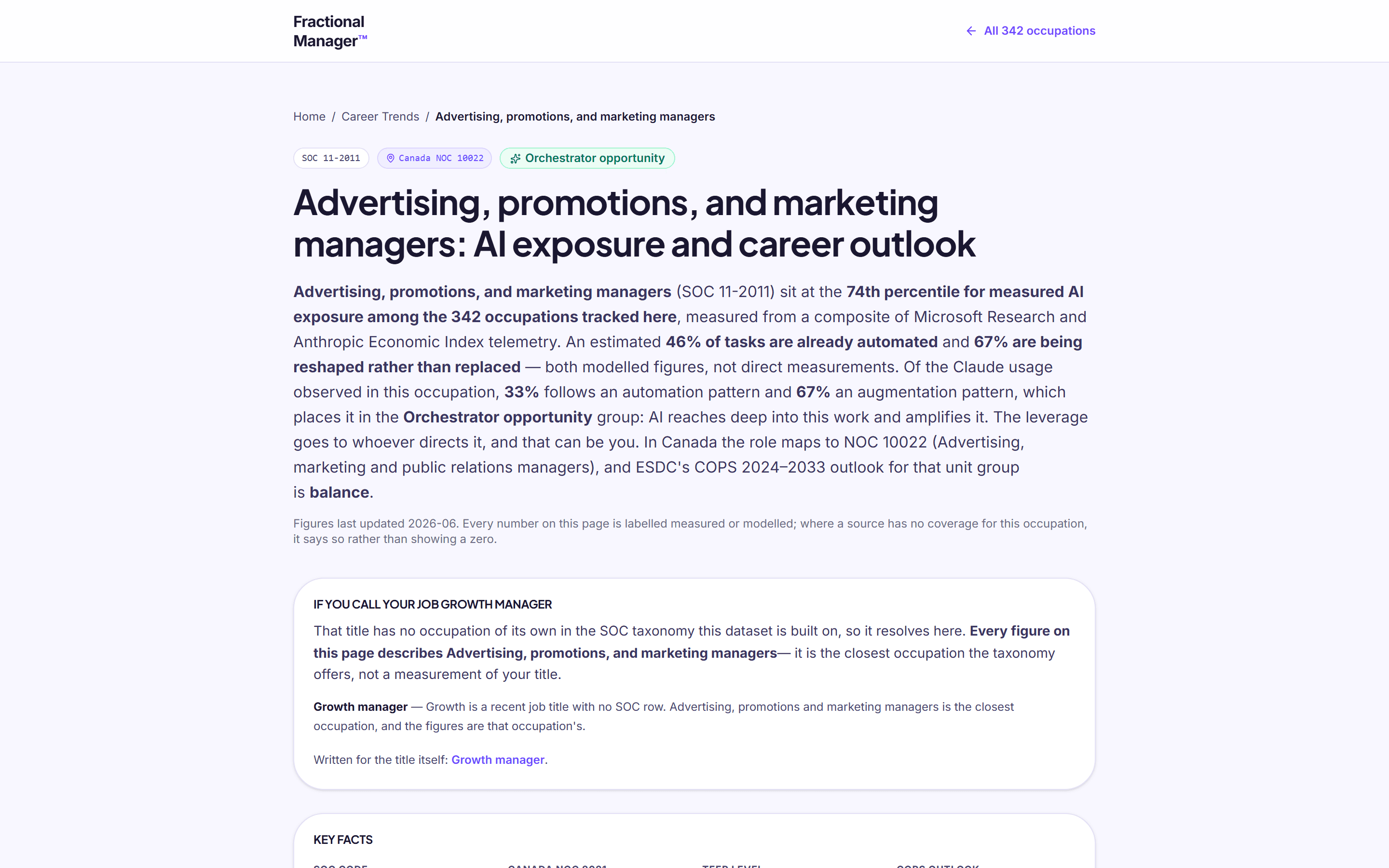
Their occupation, measured. Every one of 342 occupations has a public row scored on observed AI usage, labelled measured or modelled. Open a client’s row before they arrive. Ten seconds, no account.
The live component, with a sample profile. Yours is built from your own resume. Scroll sideways on a narrow screen.
A skill map, not a score. The resume is read into core competencies, transferable skills and an AI chapter, every node editable. Work they never wrote down is work it cannot see, which is the first thing to ask about.
Identity & Positioning
▲1Rated 4 of 5 · Strong
Output & Credibility Assets
▲1Rated 3 of 5 · Making progress
AI-Enabled Capability
▲2Rated 4 of 5 · Strong
Learning & Growth
Rated 4 of 5 · Strong
Reputation & Influence
Rated 3 of 5 · Making progress
Relationship Quality
Rated 3 of 5 · Making progress
Network Strength
▼1Rated 2 of 5 · Early stage
Opportunity Flow
Rated 2 of 5 · Early stage
Autonomy & Choice
Rated 3 of 5 · Making progress
Wellbeing & Sustainability
Rated 3 of 5 · Making progress
Self-reported — no product signal
Financial Health
Rated 2 of 5 · Early stage
Self-reported — no product signal
A sample cycle. The ringed three are the ones this person chose to focus on; the arrows are movement since their last assessment.
Eleven metrics, self-rated. The three lowest surface as the priority; the client chooses up to three; the first rung on each is a twenty-minute action. The rating has to move for a cycle to count.
Also in the first seven minutes
- A five-level AI-fluency check. One placement question and six adaptive ones, feedback after each answer, from Observer to Orchestrator. A self-assessment, and it says so; ask for the last thing AI did for them.
- A profile at their own URL. Positioning line, accomplishment statements with the metrics lifted off their own CV, AI level as a badge. Evidence, not credential.
- A small, quiet room. The Hive is where the network and referrals come from for a client whose whole network was inside one building.
Concept · built for cohort 1
What you see
Sample practice
Roster
5 clients · 2 need a conversation
| Client | Cycle | AI level | Last rating | Focus |
|---|---|---|---|---|
| Priya N.Paid-media specialist, agency | Closed with gain | L2Integrator | 2 days ago | |
| Marcus T.Inside-sales representative | Open | L1Practitioner | 19 days ago | |
| Dana K.Support team lead | Past due, no re-rating | L2Integrator | 41 days ago | |
| Wei L.Reporting analyst | Open | L3Builder | 6 days ago | |
| Sam O.Accounts-payable lead | Not rated yet | Not taken | Not rated | None chosen |
Rows are in invitation order. Nothing here ranks one client against another.
The roster. Every client you invited, their cycle state, AI level and days since their last rating. It tells you who needs a conversation. It does not rank anyone.
Sample practice · client
Priya N.
Paid-media specialist, agency
Eleven metrics · cycle 1 closed with a gain on 3 of 3
Identity & Positioning
▲1Rated 3 of 5 · Making progress
Output & Credibility Assets
▲1Rated 3 of 5 · Making progress
AI-Enabled Capability
Rated 3 of 5 · Making progress
Learning & Growth
Rated 4 of 5 · Strong
Reputation & Influence
Rated 2 of 5 · Early stage
Relationship Quality
Rated 3 of 5 · Making progress
Network Strength
▲1Rated 2 of 5 · Early stage
Opportunity Flow
Rated 2 of 5 · Early stage
Autonomy & Choice
Rated 2 of 5 · Early stage
Wellbeing & Sustainability
Rated 3 of 5 · Making progress
Self-reported — no product signal
Financial Health
Rated 2 of 5 · Early stage
Self-reported — no product signal
One client. The same eleven metrics the client sees, with movement since the cycle opened, plus the audit summary, your private note, and a suggestion for the next three. The client still chooses.
Sample practice · invite a client
Send invitationCreates the account and a 30-day trial. No inbox round-trip; the link signs them in.
What Sam sees on arrival
Sample practice would like to see your scorecard
They will see
- Your eleven ratings and how they move
- Your AI-fluency level
- Your audit summary
- Which metrics you chose to focus on
They will not see
- Your messages or Hive activity
- Your leads or workspace
- Your resume file
- Anything after you withdraw access
You can change this at any time in Settings.
Invite and consent. One email creates the account and the trial. On arrival the client sees exactly what you would see and what you would not, and decides. They can change their mind in Settings.
The programme
One cohort, ninety to a hundred and twenty days
| Week | The client does, on the platform | You do, in session |
|---|---|---|
| Week 1 | Uploads a resume and gets a skills map. Takes the three-minute AI-fluency check. Rates all eleven metrics. | Read the scorecard together. Pick the three lowest as the first cycle. |
| Weeks 2 to 4 | Takes the first 20-minute action on each focus metric. Logs real AI work as it happens. | Mid-cycle check on the roster. Adjust the three if one was wrong. |
| Week 5 | Re-rates the eleven. The cycle closes with a gain or without one. | Session two: what moved, what did not, and the next three. |
| Weeks 6 to 9 | Second cycle. Publishes a profile with a positioning line and accomplishment statements. | Session three. The profile is the first thing a stranger can evaluate. |
| Weeks 10 to 13 | Third cycle. First outreach from the workspace, if independence is the direction. | Closing session. Hand-off to self-serve, or a lighter retainer for a fourth cycle. |
Travel together
Sell it as one cohort: your clients start the same week, rate on the same rhythm, and close cycles together. You run one calendar, not five, and the roster shows the whole cohort at once.
Renew lighter
After the third cycle a client either continues on their own at the standard plan, credited to you, or stays with you for a fourth cycle on a lighter retainer. The retainer is yours to price; the record is theirs either way.
By field
Who walks in, and what the first cycle targets
Marketing & Content
A paid-media specialist whose agency cut the team when the platform started writing and testing its own variants.
First cycle: Identity & Positioning and Output & Credibility Assets: a niche in one sentence, three accomplishment statements with a metric.
9 occupations · 89th percentile mean measured exposure
Most exposed: Technical writers, Market research analysts
The evidence for this fieldSales & Revenue
An inside-sales representative whose outreach is now sequenced and personalised by software, with the team halved.
First cycle: AI-Enabled Capability and Opportunity Flow: what AI did for them this week, and where the last three conversations came from.
4 occupations · 83rd percentile mean measured exposure
Most exposed: Wholesale and manufacturing sales representatives, Sales engineers
The evidence for this fieldCustomer Service & Support
A support team lead whose first-tier queue moved to an assistant, leaving a smaller team for the hard conversations.
First cycle: Identity & Positioning and Relationship Quality: the value that was never on the job description, and a mentor outside the old employer.
2 occupations · 98th percentile mean measured exposure
Most exposed: Customer service representatives, Computer support specialists
The evidence for this fieldAnalysis & Insight
A reporting analyst whose dashboards and variance notes now draft themselves, and who is asked to check them instead.
First cycle: Output & Credibility Assets and Learning & Growth: an example a stranger could evaluate, and one new service they could sell.
3 occupations · 93rd percentile mean measured exposure
Most exposed: Operations research analysts, Management analysts
The evidence for this fieldFinance & Accounting
An accounts-payable lead whose month-end close was automated, and whose remaining work is exceptions and controls.
First cycle: AI-Enabled Capability and Network Strength: the last thing AI did for them, and live conversations outside the company.
5 occupations · 81st percentile mean measured exposure
Most exposed: Financial analysts, Bookkeeping, accounting, and auditing clerks
The evidence for this fieldA client outside these five fields still has a measured row. Look them up in the directory first; the honest answer for some occupations is that the exposure is low and the ladder is intact.
Open the AI impact directory
Compared
This is not an application tracker
| An application tracker | This instrument | |
|---|---|---|
| What it measures | Applications sent, interviews booked, offers received. | Measured exposure of the client's own occupation, a skills map, an AI-fluency level, and eleven self-rated metrics that have to move. |
| What the client keeps | A list of jobs applied for. | A record of every cycle, a public profile at their own URL, and the loop that keeps running after you stop meeting. |
| What you see | Activity: who applied this week. | Movement: which of the eleven metrics rose since the cycle opened, and which stalled. |
| What it is built for | Getting the next job like the last one. | Readiness for work where AI does the repeated part, whether the client stays employed or goes fractional. |
| What it is not | A measure of whether the last job still exists. | A job board, a course library, a matching service, or a promise of a title. |
How it is priced
You bundle it. We do not sell to your client's employer.
Cohort 1 is free
Coaches in the first cohort pay nothing for ninety days, and neither do their clients. We are testing whether the roster earns its place in your practice, not what it is worth yet.
The coach seat is free
You pay for client access, not for a login. Per-client pricing is set with the second cohort and priced to sit inside your programme fee, so the platform is a line in your package rather than a second invoice for the client.
The client keeps it
When the engagement ends the client keeps access for thirty days, then continues at the standard individual plan or stops. If they continue, they stay attributed to you.
Publicly funded services
A free coach seat and the standard client trial, with no invoice and no procurement. Tell us your setting on the form and we will set it up that way.
The rules
What we will not bend, even if it costs the sale
- Consent is the client's. You see a client's data only after they grant it on arrival, and they can withdraw it from their settings at any time. There is no admin view and no coach override.
- A review surface, not a leaderboard. No ranking of clients, no streaks, no points, no comparison across clients.
- No directory and no matching. The platform does not introduce clients to coaches. You bring the client.
- No coach-authored content. You get the scorecard, the loop and the evidence, not a course builder. There is more free AI-upskilling content in the world than anyone can use; the scarce thing is honest measurement.
- We sell to coaches and to firms that employ coaches. Never to a client's employer.
- We name what the work is and never what it pays. The instrument promises a capability, not a title.
- Self-rated metrics are labelled self-rated, on your screen exactly as on the client's. Wellbeing and Financial Health carry no platform signal and the page says so.
The other side
What these numbers do not say
The same Stanford paper that measures the entry-level gap is explicit that there is no economy-wide displacement. Most of a practitioner's caseload is not in the exposed band, and the instrument's first job is to say so when it is true.
The authors find no widespread, economy-wide displacement; the effect is concentrated on young workers in roles built on codified knowledge.
Brynjolfsson, Chandar and Chen, Stanford Digital Economy Lab · 2026-08-12 · verified 2026-09-18
Canada does not yet show the displacement signal the US data does. The age pattern is visible; the cause is not attributable, and Statistics Canada says so.
From November 2022 to December 2025, employment grew at similar rates regardless of AI exposure; workers 15 to 29 grew about 5% against about 10% for 30 to 49, and the authors cannot separate AI from post-pandemic adjustment, demographics and trade.
Mehdi and Frenette, Statistics Canada, Canadian employment trends in the era of generative AI · 2026-01-28 · verified 2026-09-18
Organisations expect more AI-driven headcount reduction than they deliver. A client told their role is gone next year is being told a forecast, and forecasts here have run about two to one ahead of what happened.
39% of respondents expect AI to reduce headcount in the next year, while only 14% say last year's predicted reductions materialised.
McKinsey, The State of AI 2026 · 2026-08-25 · verified 2026-09-18
Questions
Questions practitioners ask
- Who owns the client's data?
- The client. They grant you a view of it when they accept your invitation, and they can revoke that view from their settings. When the engagement ends, the record stays theirs.
- What do I see that the client does not?
- Nothing. You see the same scorecard, the same cycle history and the same profile, plus your own private notes. The client can see that you have access and what it covers.
- What happens after the programme?
- The client keeps access for a further thirty days, then continues at the standard individual plan or stops. Either way they keep the record. If they continue, they stay attributed to you.
- I work in a publicly funded employment service. Can I use it?
- Yes. The coach seat is free and your clients come in on the standard trial. There is no invoice and no procurement. Tell us your setting on the form below.
- Does it write the client's resume or apply for jobs?
- No. It reads a resume into a map of what the client can do and asks them to correct it. It does not send applications and it is not a job board.
- What are the eleven metrics?
- Identity & Positioning, Output & Credibility Assets, AI-Enabled Capability, Learning & Growth, Reputation & Influence, Relationship Quality, Network Strength, Opportunity Flow, Autonomy & Choice, Wellbeing & Sustainability, and Financial Health. Each is rated one to five by the client. The three lowest surface as the priority, and the rating has to move for a cycle to count.
Cohort 1
Request cohort 1 access
Prefer to see it first? The workshop deck is the same argument with the slides.
Sources
Every figure on this page
- Brynjolfsson, Chandar and Chen, Stanford Digital Economy Lab · 2026-08-12 · verified 2026-09-18
- Upwork Research Institute, In-Demand Skills 2026 · 2026-02-04 · verified 2026-09-18
- Canadian Career Development Foundation, dmh associates and CareerChatUK, via Magnet · 2026-06-12 · verified 2026-09-18
- CERIC survey, reported in CareerWise by Shreya Urvashi · 2026-08-18 · verified 2026-09-18
- Fractional Jobs, The Fractional Work Report 2026 · 2026 · verified 2026-09-18
- Mehdi and Frenette, Statistics Canada, Canadian employment trends in the era of generative AI · 2026-01-28 · verified 2026-09-18
- McKinsey, The State of AI 2026 · 2026-08-25 · verified 2026-09-18
Occupation figures are computed from the dataset behind the AI impact directory. Market sizes, coach-software prices and outplacement rates were researched for this channel and deliberately left off this page: they come from vendor surveys and secondary compilations, and a number that cannot be checked does not belong on a page written for people who check.